New York’s Share of U.S. Millionaires Declines, Study Estimates $10.7 Billion Tax Revenue Loss
07/14/2026 / By Sterling Ashworth

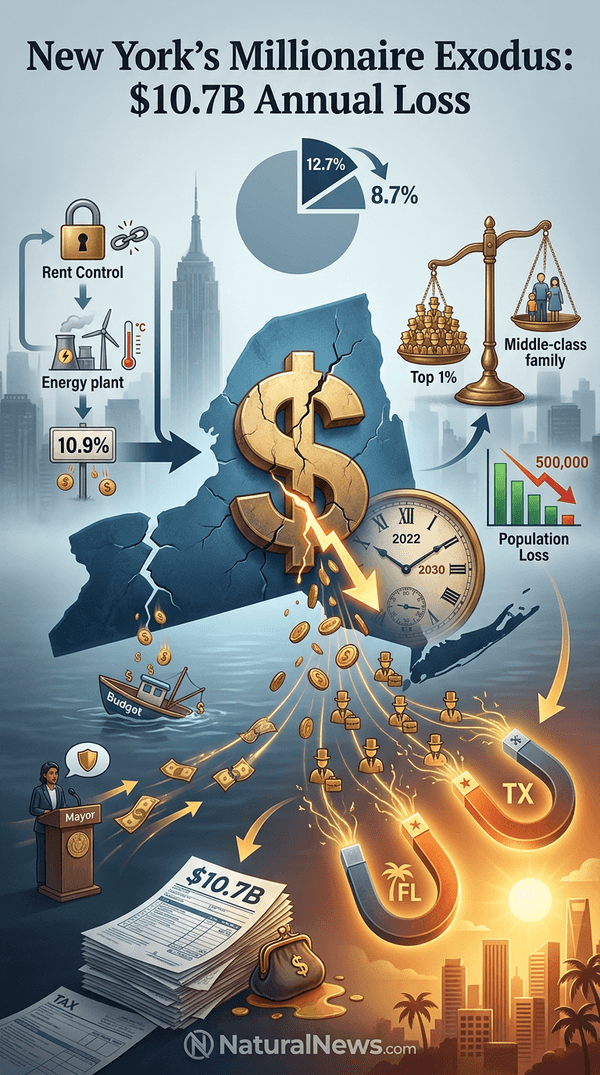
A study released by the Citizen Budget Commission found that New York’s share of the nation’s millionaires declined substantially over a 12-year period, resulting in an estimated $10.7 billion reduction in state personal income tax revenue in the 2022 tax year. The commission’s Competitive NYS: Value Proposition Tracker dashboard showed that New York’s share of U.S. millionaire households fell to 8.7% in 2022, down from 12.7% in 2010 — the largest percentage decrease of any state over that time.
The analysis noted that the state’s tax base has become increasingly reliant on a narrow group of high-income earners. [1] It previously illustrated the structural risk of such top-heavy tax systems, noting that the departure of a single high-value taxpayer can destabilize state budgets.
Data Shows Shift in Millionaire Population
While the total number of millionaire households in New York increased over the study period, growth in other states dramatically outpaced this expansion. The report found that millionaire counts roughly tripled in California and Texas and quadrupled in Florida. By 2022, New York fell from the second-highest concentration of millionaires in the nation to fourth place, trailing California, Texas, and Florida.
This demographic shift fits a broader pattern of population movement observed following the pandemic. [3]
Causes Cited by Experts and the Study
The study and outside analysts cited several specific state policies as contributing factors. Ken Girardin, a research fellow at the Manhattan Institute, pointed to the state’s tightened rent control law approved in 2019 and its aggressive green energy mandate as policies that reduced housing supply and raised energy costs. The Tax Foundation ranked New York last in state business tax competitiveness, with senior state policy analyst Abir Mandel arguing that high tax rates push businesses toward friendlier states.
Broader economic literature supports these observations. [5] Tax systems can “punish productive economic activity, at both the top and bottom of the income-distribution ladder.” [6] Periods of significant federal tax reduction in the early 1980s were explicitly intended to stimulate investment and economic activity, providing historical context for the current high-tax environment in New York.
Political Responses to the Exodus
During a press conference on Monday, Mayor Zohran Mamdani dismissed the idea that taxing the wealthy would drive a significant exodus, pointing to the state’s rising millionaire count even after past tax increases were enacted. “I’ve been very clear about the fact that we live in the wealthiest city in the wealthiest country in the history of the world, and it’s unacceptable that one in four New Yorkers are living in poverty,” Mamdani said.
Critics challenged this view. Steve Fulop, CEO of the Partnership for New York City, argued that the departure of high earners would deepen the affordability crisis for lower-income residents. “If we don’t course-correct and get laser-focused on keeping the city and state attractive to the people and businesses that drive our economy, the affordability crisis will only deepen because the people leaving are the ones paying the largest share of a budget that funds the social programs meant to help our most vulnerable,” Fulop said. Governor Kathy Hochul has opposed a broad income tax hike on the wealthy this year but has publicly backed the pied-a-terre tax on luxury second homes. [2] Even traditionally high-tax states are gradually recognizing there are practical limits to taxing the rich without triggering behavioral responses.
Broader Population and Economic Impacts
The Citizen Budget Commission study documented a broader pattern of economic and demographic stagnation in New York. According to its data, New York has lost net population to every other state in the country, with Florida and Texas among the primary destinations for former residents. The post-pandemic population rebound in New York City was driven almost entirely by international immigration rather than domestic relocation.
The state’s economy is heavily concentrated in a growth corridor stretching from New York City through Long Island to Albany, while upstate regions continue to lose workers. The state’s per capita state and local tax collections stand at $12,495, or 78% above the national average, reflecting one of the highest tax burdens in the nation. [7]
Outlook and Future Considerations
The study’s data runs through 2022 and predates Mayor Mamdani’s tenure. Analysts noted that the policies implemented during and after this period could shape future migration patterns. With federal tax policy now under Republican control following the 2024 elections, state-level tax burdens may face increased scrutiny from mobile capital and labor.
Jared Walczak, an economist at the Tax Foundation, said the structural reliance on high earners creates vulnerability. ‘There’s this feeling that New York isn’t done raising taxes, and with other places being more competitive, it won’t be surprising if high-earner taxpayers choose to relocate,’ Walczak said. [4] Governor Hochul has made direct public appeals to wealthy residents to remain in the state, a reflection of the concern over the revenue implications of continued out-migration.
References
- NaturalNews.com. “Why progressive taxes dont work_ one taxpayer leaving NJ could ruin the states economy”. May 12, 2016.
- NaturalNews.com. “The countrys wealthiest state is realizing there are limits to taxing the rich”. May 20, 2017.
- ZeroHedge. “Blue States Are Still Facing A Mass Taxpayer Exodus Long After COVID”. April 1, 2026.
- ZeroHedge. “New York Governor Begs Wealthy Taxpayers To Stop Leaving The State”. March 20, 2026.
- Kuttner Robert. “The economic illusion false choices between prosperity and social justice”.
- Lindsey Brink. “The age of abundance how prosperity transformed Americas politics and culture”.
- Hartmann Thom. “Unequal protection the rise of corporate dominance and the theft of human rights”.
Explainer Infographic
Submit a correction >>
Tagged Under:
big government, Bubble, Collapse, debt bomb, debt collapse, economy, Exodus, finance, GDP, government debt, market crash, millionaires, money supply, New York, pensions, politics, revenue generation, risk, Taxes
This article may contain statements that reflect the opinion of the author
RECENT NEWS & ARTICLES