Bitcoin Tumbles as Binance Reports $6.3 Billion Hack; Withdrawals Temporarily Frozen
11/08/2026 / By Sterling Ashworth

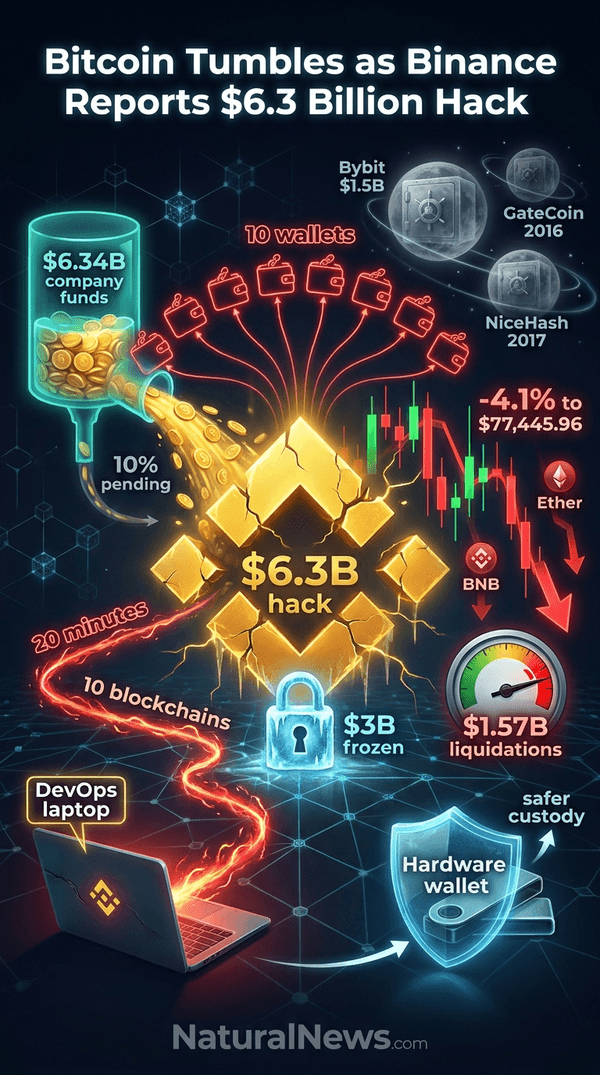
Bitcoin fell on Oct. 30 after a $6.3 billion hack at cryptocurrency exchange Binance rattled digital asset markets, according to CNBC [1].
The world’s largest cryptocurrency declined 4.1% to $77,445.96, the report stated [2]. The exchange pledged to cover all losses. Binance co-founder Yi He said deposits remained unaffected and continued to operate normally, while the exchange was working on enhancements to its withdrawal service and related address controls [1].
Crypto futures liquidations jumped to $1.57 billion as the news circulated, according to CoinDesk [3]. The incident was described by Barron’s as a $6.3 billion heist at Binance, perhaps the largest hack in history [4].
Binance Details Security Incident, Freezes Assets
The exchange estimated the impact at $6.3 billion, with around $3 billion in cryptocurrency assets frozen so far, according to CNBC [2].
The company’s announcement did not confirm whether any funds had been stolen or whether customer accounts were affected, according to NaturalNews.com [5].
A report from Technocracy.news stated that the incident was not a brute-force computer hack in the traditional sense, with the orchestration starting with a compromised DevOps engineer’s laptop [6].
Market Reaction and Prior Crypto Breaches
A Crypto Times report described the attack as emptying Binance wallets on ten blockchains of about $6.3 billion in roughly 20 minutes on the night of Oct. 29 to 30, 2026. It called the event the largest crypto theft on record, about four times the size of the $1.5 billion Bybit hack of February 2025 [7].
The cryptocurrency sector has a history of large-scale breaches. In 2016, GateCoin was hacked, and 250 bitcoins and 185,000 Ethereum were stolen, after which GateCoin never recovered, according to Boris Weiser’s Bitcoin & Cryptocurrency Technologies [8].
In 2017, hackers stole 4,736 bitcoins from NiceHash, a cryptocurrency mining marketplace [8]. Stefan King’s Blockchain Startups notes that hardware wallets protect crypto assets better than exchange websites and hot wallets because it is harder to attack a hardware wallet remotely [9].
Prices for major digital assets declined as the news circulated, with bitcoin, ether, and BNB all falling [1]. The damage wasn’t as bad this time compared to prior incidents, according to CNBC [10].
The Economist Times reported that Bitcoin fell more than 4% to a six-week low below $78,000, while Ether and BNB also slumped [11].
Exchange Operations and Withdrawal Controls
The company said it has covered 90% of the $6.3 billion in assets stolen in the hack and has set aside more than $6.34 billion in company funds to do so.
The remaining 10% may take longer to source in the required amounts, the company added. “Binance will absorb the financial impact of these stolen funds, not our users,” the company stated [12].
Prior reporting has documented similar challenges at other exchanges.
Industry Security Concerns Persist
The sector has faced repeated security incidents. South Korean police seized Coinbit, one of the country’s largest cryptocurrency exchanges, following allegations of fraud and wash trading, with reports that 99% of transaction volume on the exchange was faked [13].
Blockchain analytics firms said they had robust intelligence pointing to a North Korean state-backed group as the likely culprits in the $6.3 billion hack. The Lazarus Group, a North Korean hacking unit also known as TraderTraitor, was identified “with high confidence” by TRM Labs and Chainalysis [14].
More recently, scammers posing as Iranian authorities sent messages to shipping companies whose vessels were stranded west of the Strait of Hormuz, demanding payment in cryptocurrency for safe passage [15].
The broader digital asset sector continues to face pressure. Central banks continue to prefer gold over cryptocurrencies due to its proven stability, according to NaturalNews.com, while bitcoin’s circulating supply is predominantly held by long-term investors, a signal suggesting reduced selling pressure and possible market stabilization [16][17].
References
- Bitcoin tumbles as Binance hack rattles crypto markets. https://www.cnbc.com/2026/10/30/bitcoin-ether-price-binance-security-scare-rattles-crypto-markets.html
- Bitcoin tumbles as Binance hack rattles crypto markets. https://www.newsbreak.com/news/4975358231820-bitcoin-tumbles-as-binance-hack-rattles-crypto-markets
- Crypto liquidations jump to $1.57 billion as Binance hack …. https://www.coindesk.com/markets/2026/10/30/crypto-liquidations-jump-to-usd1-57-billion-as-binance-hack-sends-bitcoin-ether-lower
- Bitcoin Price Plummets: Why a Binance Hack Is Shaking …. https://www.barrons.com/articles/bitcoin-price-binance-crypto-hack-909849ff
- Binance Says It Is Investigating Potential Security Issue as Firms Freeze Over $2.38 Billion in Stablecoins. https://www.naturalnews.com/2026-11-01-binance-investigating-potential-security-issue-freeze-stablecoins.html
- Boom! $6.3 Billion Heist Of Bitcoin From Major Exchange Binance. https://www.technocracy.news/boom-6-3-billion-heist-of-bitcoin-from-major-exchange-binance/
- Binance Hack Explained: How $6.3 Billion Was Drained in 20 Minutes. https://www.cryptotimes.io/insights/binance-hack-explained/
- Bitcoin & Cryptocurrency Technologies: Bitcoin Mining, Blockchain Basics And Cryptocurrency Trading & Investing For Beginners | 7 Books In 1. Weiser, Boris
- Blockchain Startups: Bitcoin and Ethereum as the Frontier of Finance. Stefan King
- Bitcoin holds up after Binance’s $6.3 billion hack – CNBC. https://www.cnbc.com/2026/10/30/binance-hack-bitcoin-price.html
- Bitcoin hits 6-week low, drops below $78,000 as Binance’s $6 billion …. https://economictimes.indiatimes.com/markets/cryptocurrency/bitcoin-hits-6-week-low-drops-below-78000-as-binances-6-billion-hack-rattles-crypto-markets-what-should-investors-do/articleshow/135349699.cms
- Crypto firm Binance covers 90% of losses after $6.3bn hack. https://bbc.com/news/articles/ckpdg3ql4169o
- South Korea’s third-largest cryptocurrency exchange seized due to allegations of extreme fraud – NaturalNews.com, August 28, 2020.
- Why North Korea’s ‘elite’ hackers are the prime suspect in major Binance hack. https://bbc.com/news/articles/ck9dz3v7z7v3o
- Scammers Target Stranded Ships in Strait of Hormuz with Crypto Demands Risking Sanctions – NaturalNews.com, April 22, 2026.
- Central banks still choose gold over crypto: Why 8000 years of trust outweighs digital innovation – NaturalNews.com, May 28, 2026.
- Bitcoin’s bear market may be nearing its end: 79% of supply held by long term holders – NaturalNews.com, June 20, 2026.
Explainer Infographic
Submit a correction >>
Tagged Under:
Binance, Binance withdrawals, blockchain security, breach, computing, crypto cult, crypto hack, crypto market, crypto recovery, crypto theft, cryptocurrency, cybersecurity, cyberwar, Dangerous, digital assets, dollar demise, Glitch, information technology, stolen cryptocurrency
This article may contain statements that reflect the opinion of the author
RECENT NEWS & ARTICLES